Open-source, hobby, and independent projects I have built over the years — in my own time, as personal work independent of any employer.
Runyte · 2026
A terminal workspace built in Rust around a modal text editor. It brings together editing, terminals, Git, and language servers, with consistent keyboard navigation and a fuzzy finder that searches files, unsaved buffers, and terminal content.
Runyte supports running CLI coding agents alongside your code, editing their prompts in the same workspace, and reading Markdown as a formatted page. Optional persistent sessions keep terminal processes and language servers running while you detach and return later. The focus is on performance, stability, and a minimal interface.
Closebytes · 2026
An interactive explorer for comparing open-source projects and discovering their nearest neighbors. It presents projects as a navigable point cloud, making discovery fun, visual, and slightly scientific.
I built it to explore the growing world of ultra-personalized software, where building from scratch or adapting a fork can be faster than waiting for an official release. That raises interesting questions: how similar projects differ, how independent projects get discovered, and where code and ideas come from as AI-assisted development becomes more common.
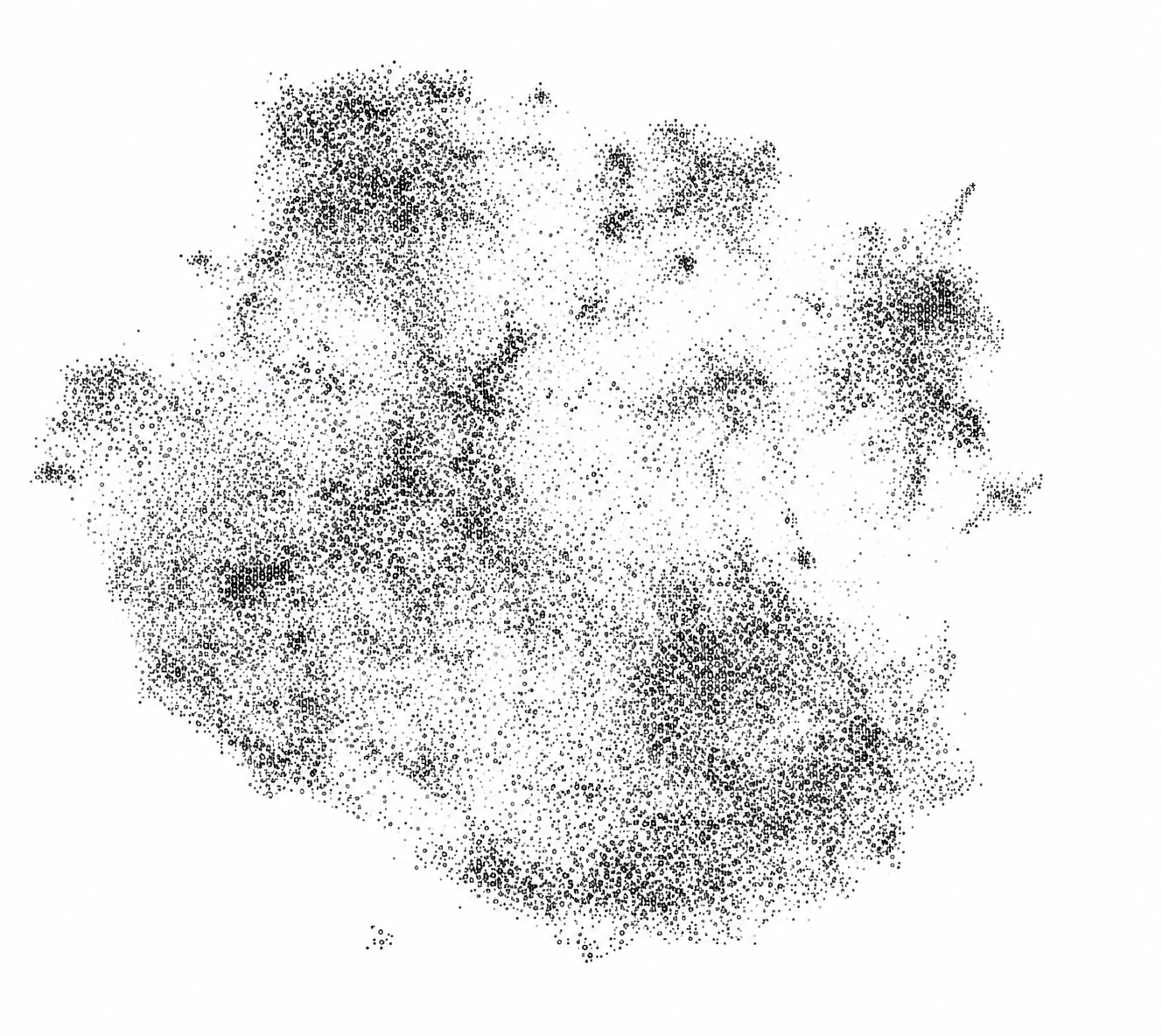
Figure: An ASCII-style rendering of the Closebytes project point cloud.
publigen · 2025–2026
An agentic system for research, monitoring, and drafting. It ingests documents into a RAG knowledge base, continuously monitors the web for relevant developments, and runs a multi-agent pipeline — topic scouting, planning, drafting, claim verification and grounding, editing, and critique — to turn that material into well-grounded drafts for expert review.
The hard parts were in the editorial pipeline: verifying each claim against its sources and hedging or dropping the ungrounded ones, learning an author’s writing style from implicit approve/reject feedback, and keeping a human in the loop on every draft.
A private, invite-only system, so there is no public repository. It taught me how much effort a production-grade agentic system really takes — today I would build much of it as Claude Code skills rather than hand-rolled orchestration.
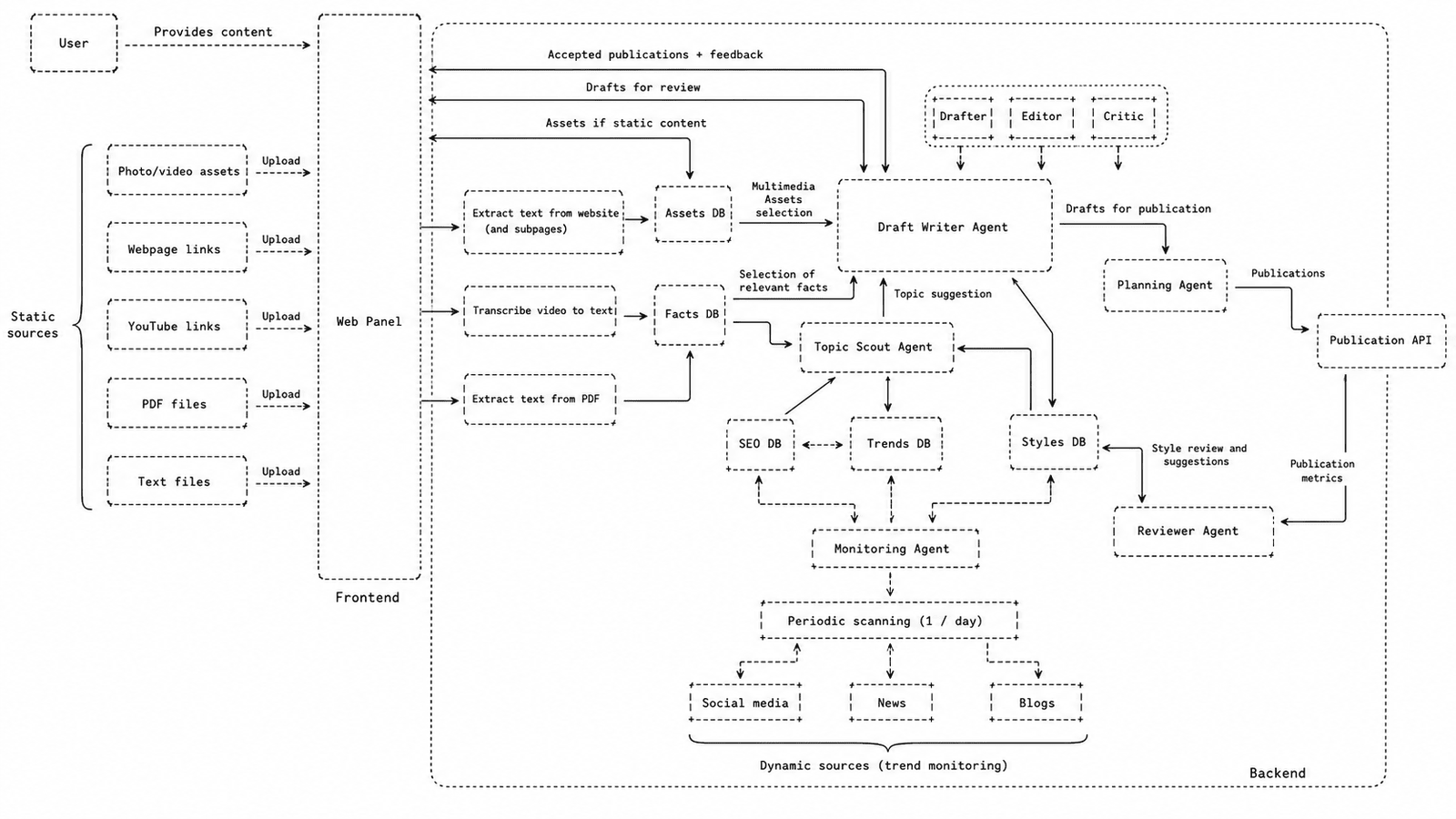
Figure: Publigen architecture — source ingestion and web monitoring feed a RAG store and a multi-agent backend that researches, drafts, and grounds write-ups for expert review.
building3d-rs · 2025–2026
Experimental Rust toolkit for procedural building geometry, simulation, and visualization. It models buildings as structured 3D objects, then layers on mesh generation, geometric queries, acoustic ray tracing, lighting analysis, weather-driven thermal simulation, and Rerun-based visualization. The project evolved into a broad research prototype: part geometry kernel, part simulation sandbox, part benchmark playground.
The energy module includes EPW weather parsing, solar position and shading calculations, ideal-load HVAC, finite-volume wall conduction, internal gains, schedules, and thermal network components. It includes BESTEST-oriented examples that compare selected ASHRAE 140 cases against OpenStudio/EnergyPlus reference outputs from the NREL BESTEST-GSR workflow, plus regression tests and generated comparison plots.
This is an ambitious experimental simulator, not a certified replacement for EnergyPlus or other professional building simulation tools.
Acoustic benchmark: BRAS CR2
To test the acoustic module, I compared simulation results against the BRAS dataset — a peer-reviewed room acoustics benchmark created by RWTH Aachen and TU Berlin. The test case is the CR2 small seminar room: 5 materials, 2 sources, 5 receivers, and in-situ measured acoustic parameters.
The simulation uses pure stochastic ray tracing with frequency-dependent absorption, hybrid specular/diffuse reflections, ISO 9613-1 air absorption, and Schroeder integration to estimate EDT, RT60, C80, and D50 across octave bands (125–4000 Hz). No image sources, FEM, or wave-based solvers involved.
Reverberation time error vs. measurements: 3–15%.
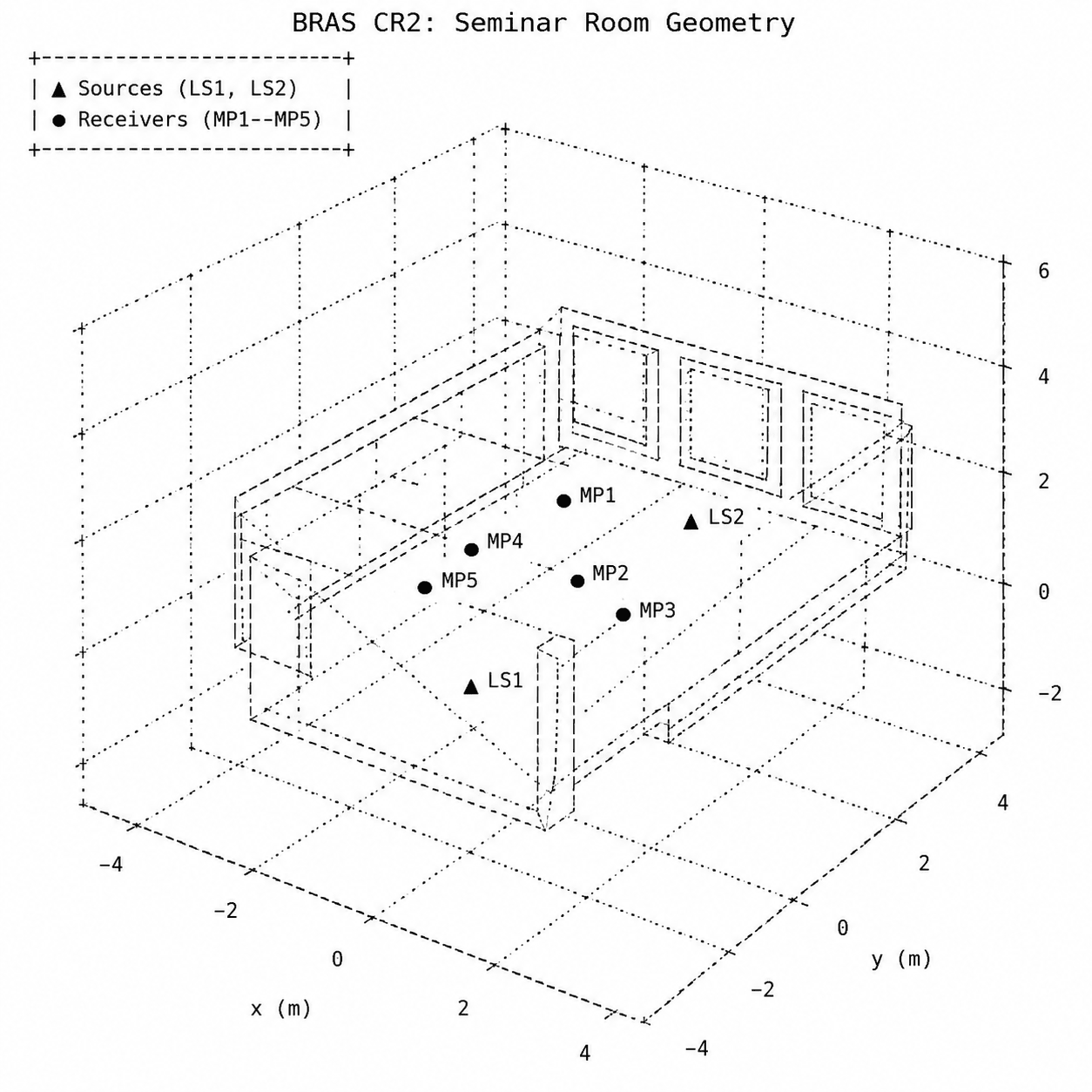
Figure: BRAS CR2 seminar room geometry with 2 sources (LS1, LS2) and 5 receivers (MP1–MP5).
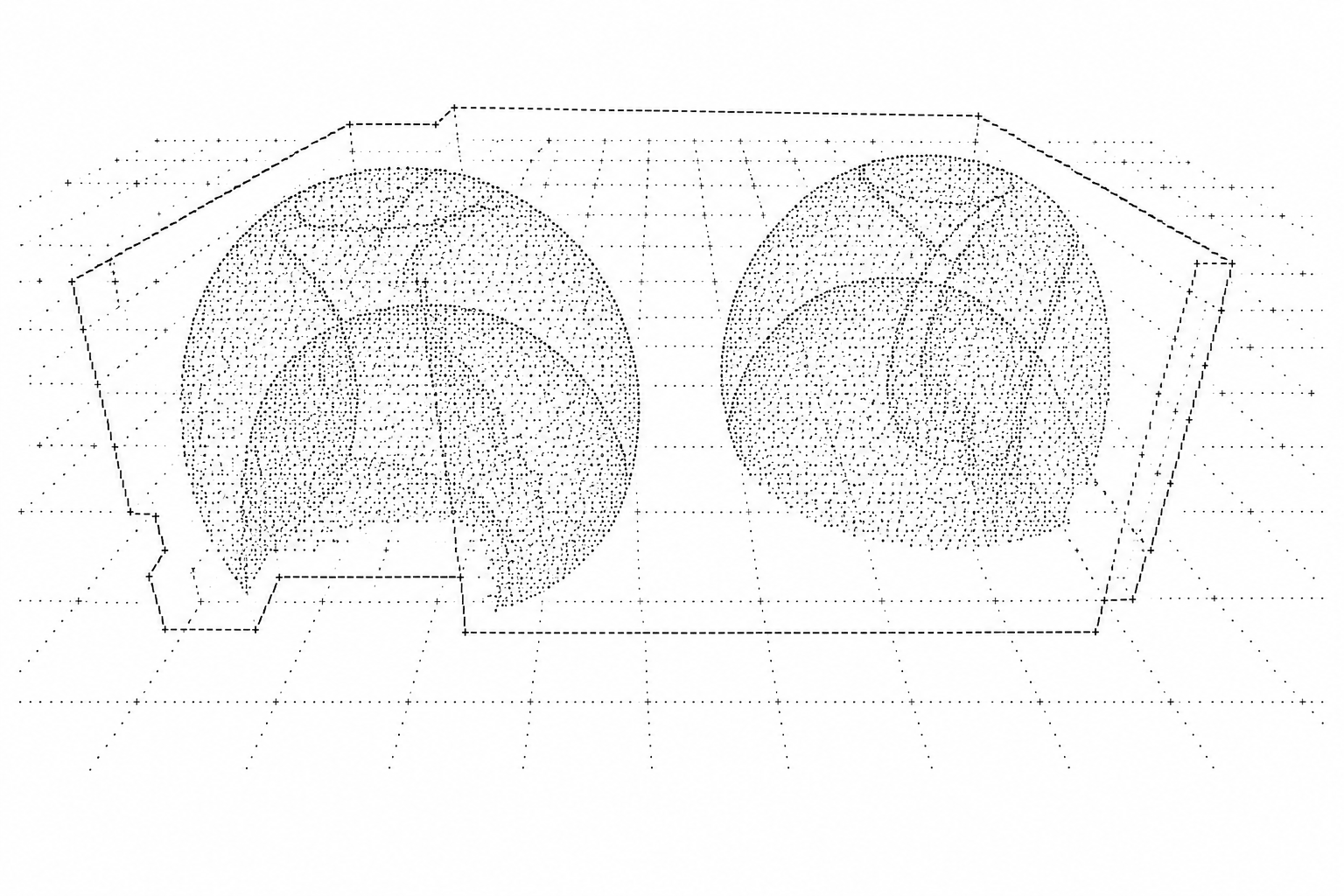
Figure: Acoustic rays from two sources at early time steps.
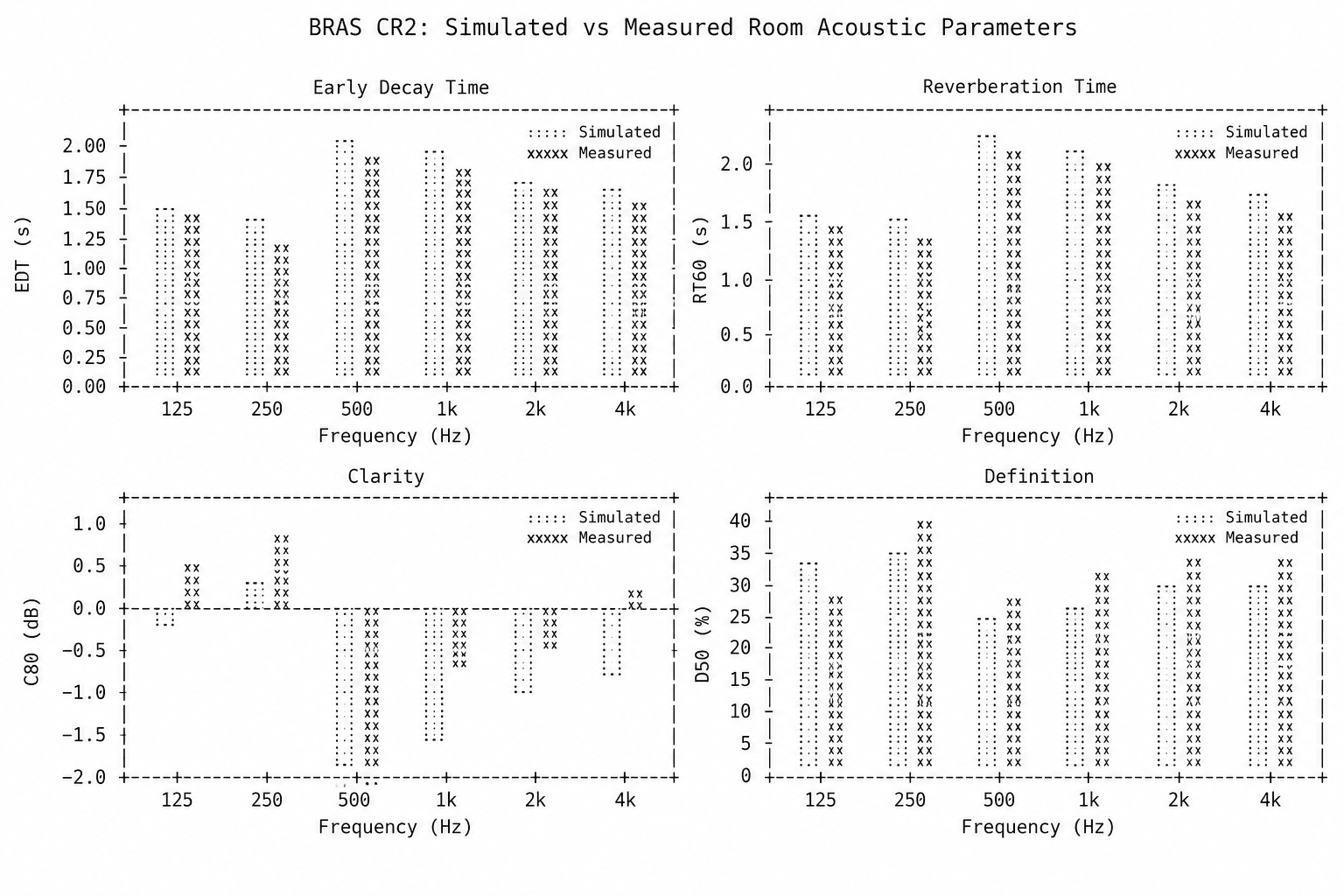
Figure: Simulated vs. measured EDT, RT60, C80, and D50 across octave bands.
building3d · 2024–2025
First iteration of the building3d project, written in Python. Superseded by the Rust rewrite above.
The clip below is an early geometry and ray tracing stress test: a Utah teapot loaded as a complex mesh to verify that rays propagate correctly through non-trivial geometry without getting lost.
modestga · 2018–2022
Parallel genetic algorithm with a SciPy-compatible interface, supporting rectangular bounds and inequality constraints. It runs across all available CPUs by default, splitting the population into per-CPU subpopulations that exchange genes after each generation. Features adaptive mutation and is designed for large-scale non-convex problems. Useful as a drop-in optimizer in simulation and engineering workflows.
I benchmarked it against Differential Evolution (SciPy) and naive Monte Carlo on the Rastrigin function. For large-scale problems (N > 32), modestga achieves similar or better results in significantly shorter time.
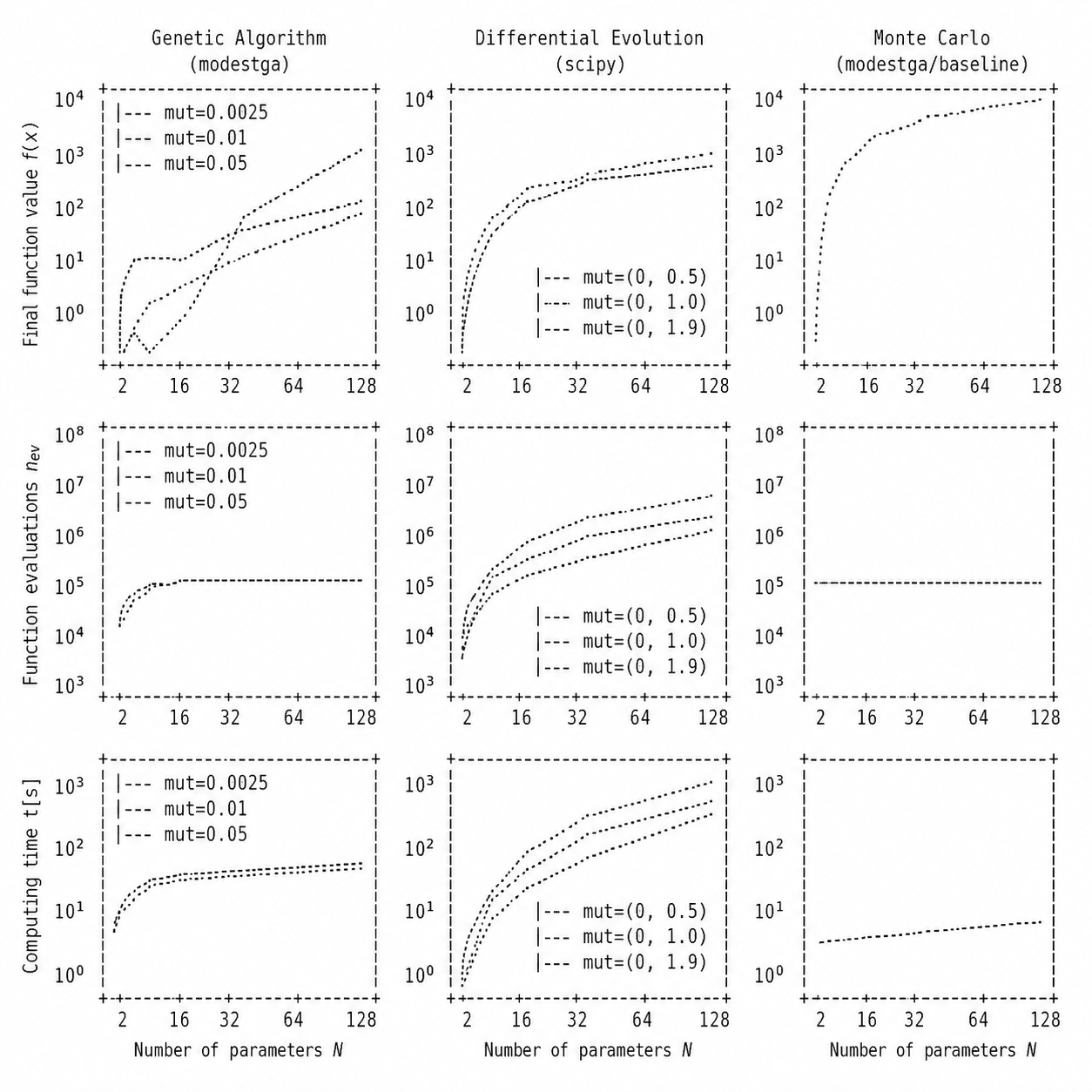
Figure: Comparison of modestga, Differential Evolution (SciPy), and Monte Carlo on the Rastrigin function. Mean of five runs, population = 100, max 1000 generations.
modest-py · 2017–2022
FMI-compliant parameter estimation for gray-box models in Python. Designed to work with models developed in Modelica and compiled to FMUs. FMI (Functional Mock-up Interface) is an open standard for exchanging simulation models as self-contained units called FMUs (Functional Mock-up Units).
ModestPy supports running multiple optimization algorithms in user-defined sequences — for example, a global genetic algorithm (GA) followed by a local gradient-based method — making it easy to handle non-convex cost functions without committing to a single solver. Whenever GA is used, the tool automatically generates a parameter evolution plot like the one below.
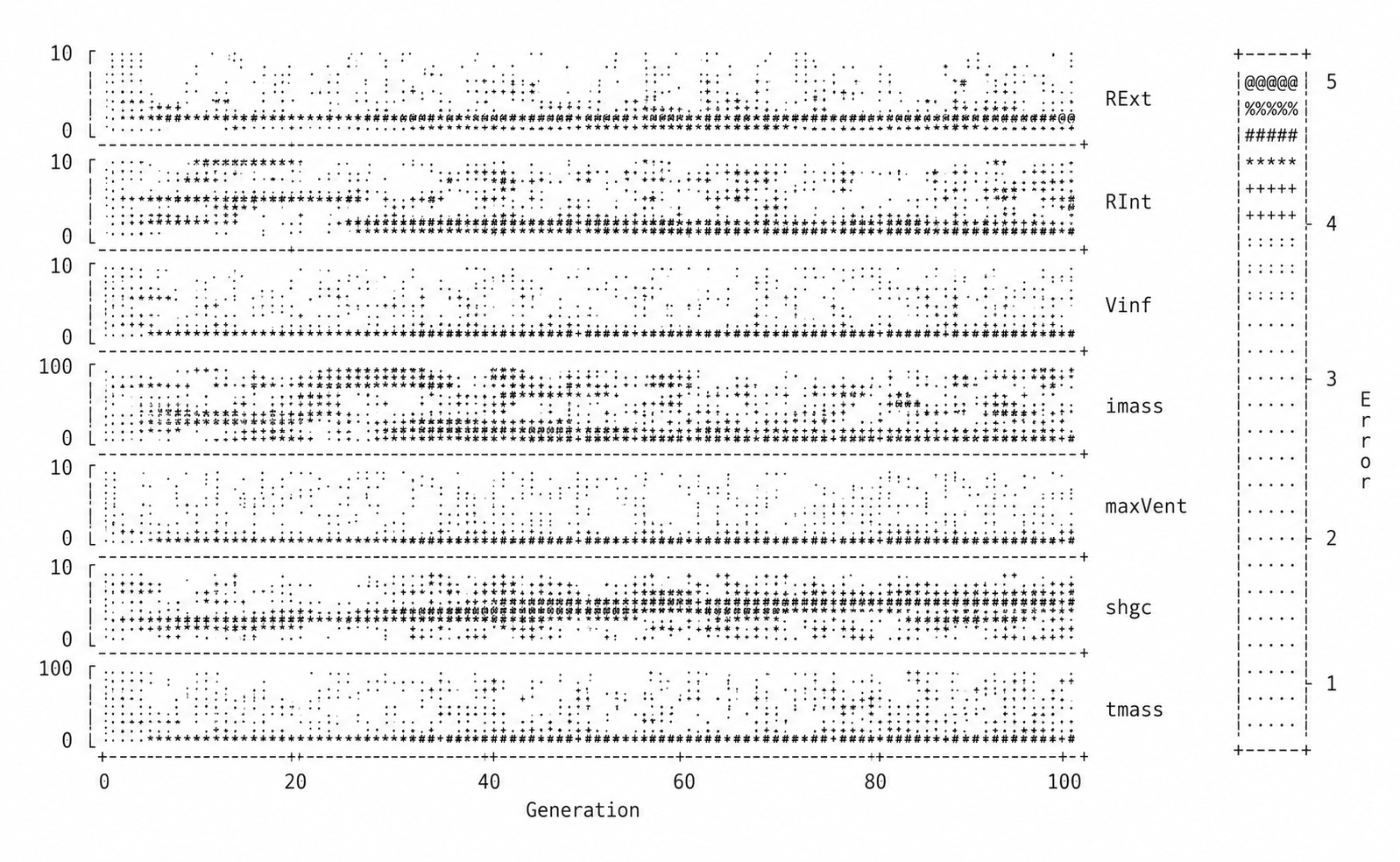
Figure: Parameter evolution across 100 generations of the genetic algorithm, applied to a gray-box building zone model with 7 estimated parameters. Each row tracks one parameter; every dot is one individual in the population, with training error (NMSE) indicated by marker shade. The population converges from a broad spread across the search domain toward a narrow, low-error band.
mshoot · 2018–2019
Python framework for Model Predictive Control using the multiple shooting method. The optimization horizon is divided into N subperiods, each simulated independently. A nonlinear programming solver then enforces state continuity between subperiods and minimizes a cumulative cost function subject to state and input constraints. The framework integrates with FMU-based simulation models, making it straightforward to apply MPC to building energy systems modeled in Modelica or other FMI-compliant tools.
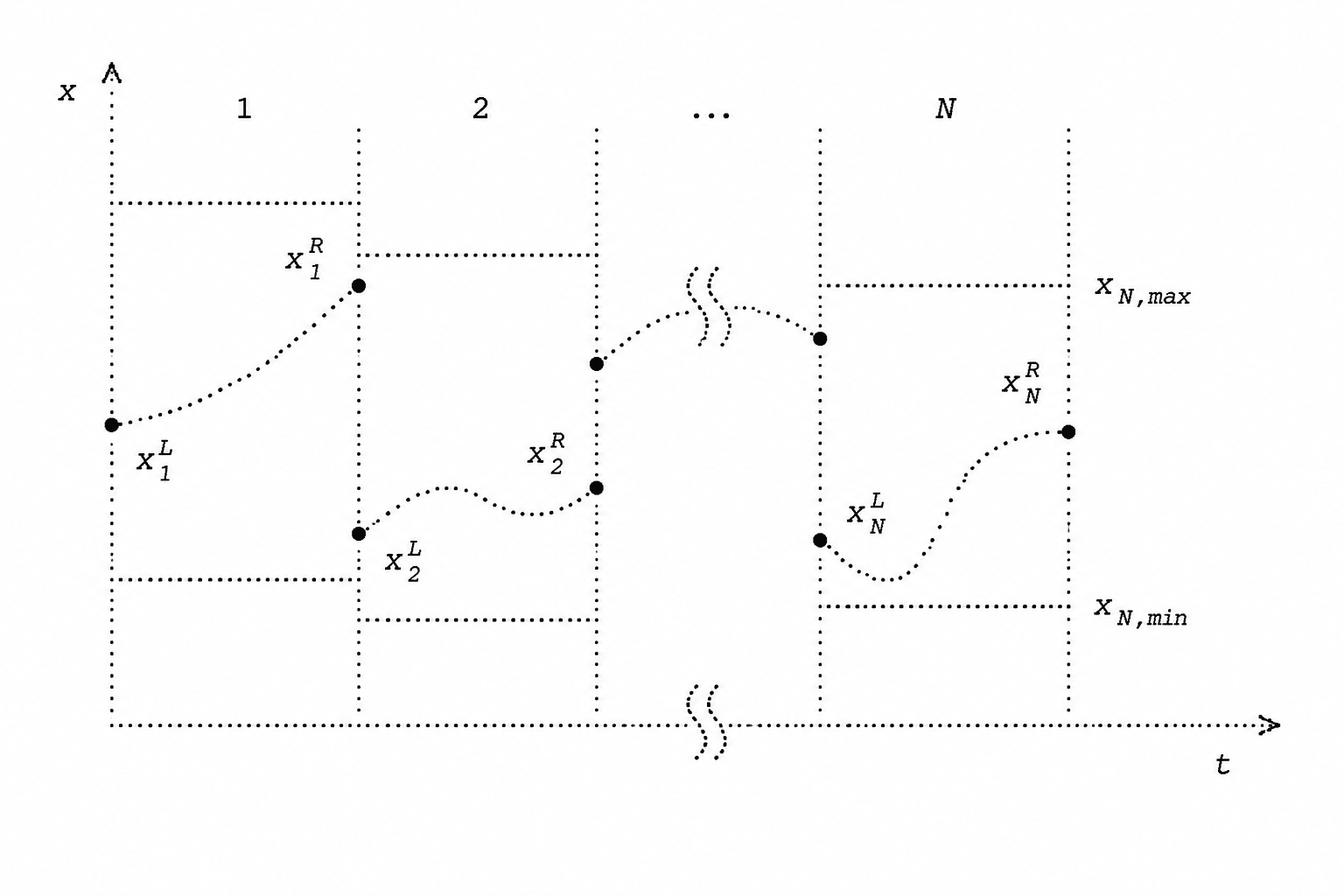
Figure: Multiple shooting divides the horizon into N subperiods. State continuity (xRk = xLk+1) is enforced as an NLP constraint.
epquery · 2017–2019
Python tool for editing EnergyPlus IDF files programmatically. Simplifies scripted manipulation of building energy simulation input files. There are now better tools for this, but when I wrote epquery there was nothing similar available.